
Romantasy Can Do Better
A folklorist's opinion on the shortcomings of the literary phenomenon.

N.B. I do not often delve into outright opinion pieces, and though this article is grounded in folkloristic research, it is largely shaped by personal views. If you love what you read then read what you love, we certainly need more of that!
Though the title of this article might appear contentious, for some of you, my sentiments on the ever-swelling beast that is romantasy literature will come as no surprise. I briefly touched upon my personal opinions of romantasy in a recent essay on the historical evolution of the fairy abduction, and after careful consideration and a number of interested comments, decided my misgivings about the genre really deserved a more in-depth explanation.
Before I begin poking holes in this literary phenomenon, I must make something quite clear: from my modest perspective as an everyday reader, I am unperturbed by the recent rise of romantasy literature. I have always believed that encouraging more causal readers by whatever means in a society that is becoming increasingly indifferent to literature can only be a good thing. If you like to read then, of course, read what you like. That being said, as an eternally pedantic folklorist I find myself gnashing my teeth in anguish at the numerous betrayals the romantasy genre inflicts upon tradition. To be clear, this article examines the genre from a folkloristic perspective, insisting that if romantasy depends so extensively upon folkloric motifs, it carries a corresponding responsibility to engage with them more accurately. Recently, as I flipped through a novel depicting selkies as seductive guardians of destined love, I felt a pang of dissonance strong enough to stop me mid-page. The transformation from local cautionary tale to marketable romance symbol was stark. When a genre borrows so heavily from real folklore, the boundaries between invention and inheritance blur, and the stories that once grounded communities risk being replaced by glossy, homogenised traces. This article seeks to strip back some of that gloss.
What Exactly is Romantasy?
Before I get too carried away, we must begin with some necessary definitions. Not only will this ground the relatively nascent term ‘romantasy’ in some much needed context, it will further clarify the timeline of said term. Let’s start with the now rather neglected phrase ‘Romantic Fantasy.’ Though arguably the mother of romantasy, Romantic Fantasy is notably distinct from its literary offspring and holds a far longer history. There is often considerable confusion between the two, with some arguing that no difference exists at all. Here is where I make the distinction:
Romantic Fantasy typically treats the romance as a subplot: the fantasy world and its conflicts remain fully realised even if the romantic storyline is minimised or removed. Romantasy, by contrast, entwines the romance and fantasy elements so tightly that one cannot be separated from the other without fundamentally altering the story. In doing so, it often flattens the nuance of both components, binding the magical setting and the romantic plot so closely that neither can fully exist on its own, sacrificing the depth and complexity that each might achieve independently.
In short, while the romance plot and worldbuilding of traditional Romantic Fantasy remain mutually exclusive, in romantasy these same elements enter an unhealthily symbiotic relationship. This merging is all too fittingly captured in the very name of the genre itself: the ever booktok-able portmanteau, ‘romantasy.’ While Romantic Fantasy could feasibly encompass a long history of works that treat each generic facet—romance and fantasy—as largely individual, tracing its lineage from Tristan and Isolde to The Tempest to War for the Oaks, romantasy appears more narrowly defined. It often confines itself to a modern construct built from formulaic sequences of familiar tropes, trading the richness of variation for a predictable pattern.
No one can say with absolute certainty from where or whence the term romantasy first sprouted, though its origins remain hotly debated across the internet (where all important literary disputes unfold, naturally). Bloomsbury has made the rather audacious claim that they in fact coined the label to herald their literary superstar Sarah J. Maas and her A Court of Thorns and Roses series as the very embodiment of the genre. Yet, the term itself actually first appeared in 2008 on Urban Dictionary, long before publishers decided it was worth slapping on a book cover.
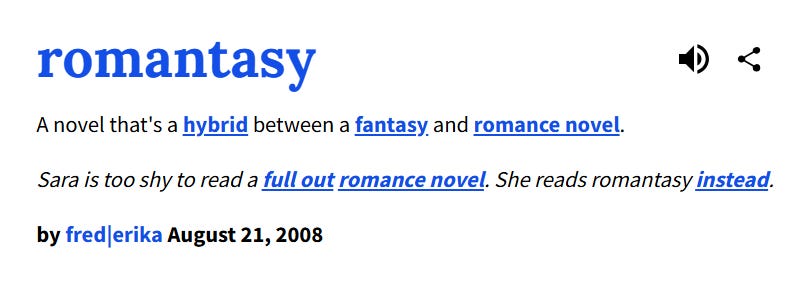
Origins aside, romantasy has exploded in recent years, spreading across bookshelves, social media feeds, and online fandoms with remarkable speed. What began as a niche fusion of romance and fantasy has become a publishing juggernaut. Though endlessly marketable, romantasy does not make any great generic strides. Rather, the term often feels like short hand for a reductive homogenisation of folkloric fantasy’s rich creative scope.
The Issues
This leads me to a break down of several issues I find repeated time and again throughout the romantasy genre. I have tried, in good faith, to welcome this development in fantasy writing with open arms, but after witnessing so many easily remedied shortcomings, those arms will remain resolutely folded until I can be convinced otherwise.
Detachment From Cultural Specificity
At the foundation of folkloristic inquiry is the recognition that traditional narratives are inseparable from the communities that create and transmit them. Though throughout academic study, we can dissect tales into constituent parts for anthropological analysis, folklore is not merely a collection of motifs or character types but a reflection of local histories, worldviews, and social structures. Romantasy, however, often treats folklore as an aesthetic resource, blending elements from disparate traditions—Celtic fairy lore, Norse cosmology, Slavic monsters, and Classic myths—into an amorphous, culturally nonspecific setting. This practice obscures the deep regional roots of the original narratives.
What emerges is a homogenised ‘mythic aesthetic,’ stripped of cultural purpose and divorced from the lived experiences that once shaped these stories. What’s more is that through this amalgamate blending, the ‘folk’ aspect of folklore is lost. By this, I mean to say that the functionality of folkloric motifs that is so integral to the persistence and social application of folklore is entirely lost in favour of glittering underworlds, franken-beasts and muscular love interests. In romantasy the fae, for instance, are rarely portrayed as morally ambiguous or dangerous; instead, they are often rendered as alluring, romanticised figures, stripped of the liminality and cultural function they occupied in traditional lore. It is all well and good to write a character with pointed ears and a left nostril that shoots fire, but exactly what is the reason for these folkloric traits? By separating the creation of uncanny creatures from the historical anxieties that originally informed them, a layer of poignant anthropological context is reduced to little more than shiny aesthetic embellishment for embellishment’s sake. Strip away the ears, the wings, the talons from a romantasy fairy king, and you are left with an ordinary man whose story could unfold just as easily in Scunthorpe as in the Hollow Lands.
Reduction of Narrative Diversity Through the Monomyth
Another significant issue concerns the narrative structures into which folkloric elements are inserted. Folktales, by their very nature, exist in vast multiplicities; variation is the norm, not the exception. Every retelling adapts to its teller, audience, and social moment, producing countless permutations of motifs, plot sequences, and character functions. This inherent fluidity allows folklore to respond to cultural shifts, ethical debates, and social anxieties, ensuring that the stories remain dynamic and relevant. Romantasy frequently flattens this narrative richness by adhering to a narrow set of predictable story templates. The hero’s journey, the chosen-one narrative, the reluctant queen, or the motif of fated mates are recurrent frameworks that structure plot development with remarkable regularity.
The effect of this compression is a homogenisation of story structure that erodes the improvisational and adaptive qualities that define traditional folk narrative. Where a folktale might evolve across centuries to emphasise local values, communal ethics, or moral ambiguity, romantasy often imposes a rigid, teleological arc, privileging romantic resolution or personal empowerment above the nuanced ethical or social lessons embedded in the original motifs. Moreover, this adherence to formula can create a sense of déjà vu across works: landscapes, characters, and conflicts may appear superficially novel, but the underlying narrative machinery remains nearly identical.
While the argument stands that similar folkloric narratives appear across diverse cultures, the rebuttal is that such repetition often reflects universal human anxieties specific to less technologically and socially secure eras. The romantasy writer, sipping a latte in a centrally heated café with necessities such as food, healthcare, and connectivity only a few buttons away, has been granted a level of comfort and detachment unimaginable to the original storytellers. With such security, the need to rely on repeated motifs for guidance or reassurance diminishes, offering far greater scope to experiment with tropes, subvert expectations, and explore novel narrative possibilities. In the modern context, the monomyth is repeated not out of need but out of ease, packaged for consumption rather than survival.
World-Building Becomes World-Flattening
Now a notion that would have Tolkein spinning in his grave: unfortunately many of the romantasy worlds I have warily sampled are disappointingly predictable and infuriatingly vague. Here are some instantly recognisable settings:
The Enchanted Court: Where every council meeting involves brooding stares, forbidden glances, and a dramatic swish of capes; political intrigue exists only insofar as it delays the inevitable kiss.
The Alluring Forest: Full of gleaming fae, whispered prophecies, and conveniently placed moonlight.
The Fated-Mate Village: A quaint hamlet where every glance, misstep, or accidental brush of hands signals destiny. We might meet the occasional disgruntled old woman or beggar-child, but aside from these one-line NPCs the village may as well be devoid of any society beyond the protagonist and those who serve their progression.
Worlds, once sites of unpredictability and imaginative exploration, become predictable, almost schematic. Readers may experience the pleasure of escapism, but it is an escapism constrained by a limited set of conventions. No matter how elaborate the castles or how intricate the courtly politics, the stakes are calibrated to romantic resolution; the world rarely asserts its own narrative authority. The effect is that the richness of folklore and fantasy is reduced to surface spectacle, once again firmly removing the ‘folk’ from folklore. These situational shortcomings often give way to the dreaded ‘white room syndrome,’ a phenomenon in creative writing in which characters move, speak, or emote in a space that feels empty because the setting is barely described. The result is that the characters appear to exist in a blank, featureless void. With no anchor in sensory detail, physical environment, or spatial context, readers are left disoriented and unable to visualise the world.
Even when more liberty is taken with locational descriptions, the world will always feel like a cardboard pantomime set when treated as so secondary to the central romantic or erotic encounter. In folklore, the very landscape continually shapes and informs the stories it produces and vice versa. There is no Nessie without the Loch just as there is no Giant’s Causeway without the giant. It is continually staggering to me that romantasy veers so sharply away from this aspect of its folkloric source. Though characters are always interacting with each other (sometimes too much!) they seldom touch the world around them or, indeed, let the world touch them. Once again the story could unfold anywhere, the magical nature of the setting doing little to inform the narrative. Fens and forests are reduced to elaborate stage sets, and characters rarely leave any true footprints in their surroundings—and not due to any fae light-footedness.
I Try To Understand
Of course, I must admit that romantasy’s charms are not lost on its audience—far from it. For many readers, the very things that make folklorists wince are precisely what make the genre irresistible. There is undeniable comfort in knowing that the brooding winged prince will, in fact, fall for the stubborn mortal girl, that the enchanted forest will be dangerous only in a narratively convenient way, and that destiny will always arrange itself around the kissing schedule. In an era of relentless real-world chaos, romantasy offers a reliably pleasant escape hatch: a place where problems can be solved by smouldering eye contact and a universe that seems suspiciously eager to aid its protagonists. One cannot begrudge readers a genre that promises both dragons and emotional validation.
And perhaps the genre is simply not for me; perhaps I am too far down the folkloristic pipeline to fully appreciate romantasy’s tropes at face value without endless pendantry. Certainly, the formula works, Sarah J Maas’s 75 million copies sold do not lie. The people crave escapism and they crave it in 300 to 500 easily digestible pages. Despite this, what I will say is that romantasy can do better even if it doesn’t have to. If this is the form that publicly accessible folkloric preservation is now taking, we must be painstakingly careful in ensuring motifs do not become meaningless, reduced or flat. A little research goes a long way in opening doors for well rounded world-building, accuracy and diverse plot structure. Drink from the well, and drink deep!
I will leave you with this thought,
Romantasy writers today have been gifted the richest, most vibrant plethora of ingredients and yet it seems time and again we are presented with the same recipe. Ultimately, no matter how fine the components, they are wasted if one does not know how to bring out their fullest potential.
You have such a unique and important perspective on this issue! I LOVE the point about romantasy's cultural detachment. Made me think about the controversy of Rebecca Yarros using Gaelic-inspired names in her very non-Gaelic world.
I really appreciate your succinct deconstruction of the homogenization of folkore that many romantasy series perpetuate, rather than a general scalding criticism of the genre itself. Romantasy absolutely can do better, and readers who enjoy the romantasy genre deserve better. Amazing article!