
England's Chalk Herd
Ever wondered about galloping geoglyphs?

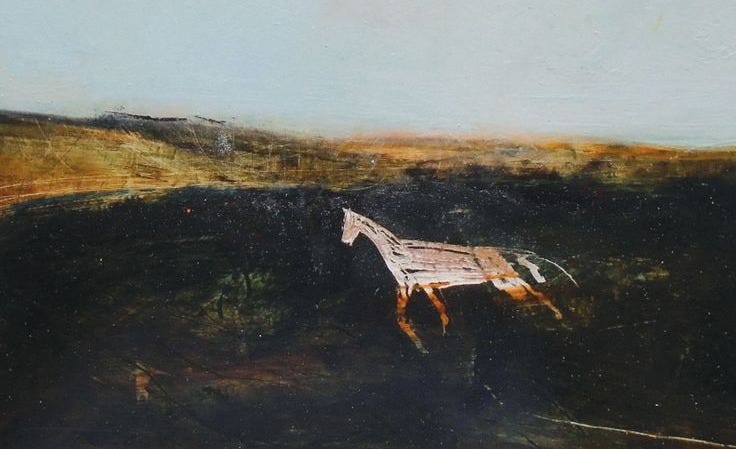
On the line between Bristol Temple Meads and London Paddington, somewhere in that long, dreamy corridor of Wiltshire where the world flattens into cornfield and chalk downland, the reward for a split-second of your attention is extraordinary. Always, through something close to pure chance, I will look up from my book, laptop or whatever fog I’ve drifted into at precisely the right moment to catch a great white charger hurtling past the train window. A collection of sharp lines scored into the hillside, the Uffington Chalk Horse keeps pace for a few brilliant seconds before the fields swallow it once more.
My chalky pal has been a source of fascination for many years, though all too often that fascination is fleeting. A flash of surprise, a mental note—I really must write about you—and then back into the inbox, where a dozen unread emails are patiently waiting to drain the magic out of everything by Didcot station. This time, you find me writing on that very same train ride. As of five minutes ago, the horse has galloped by, and I intend to do it justice before it becomes a small, white, vaguely horsey-shaped blob in my mind.
The Uffington carving is by no means a one-off act of equine eccentricity. The chalk downlands of Southern England are, in fact, absolutely littered with the things. Wiltshire alone is home to eight of them, which raises the question of what exactly was going on in Wiltshire, and whether anyone was getting any other work done. Across Oxfordshire, Berkshire and beyond, hillsides have been etched with horses that have lasted centuries. Some carvings are thought to date back over a thousand years, others are more recent but no less baffling. So what is this great herd doing galloping across the south of England? How did they come to be ? And why?
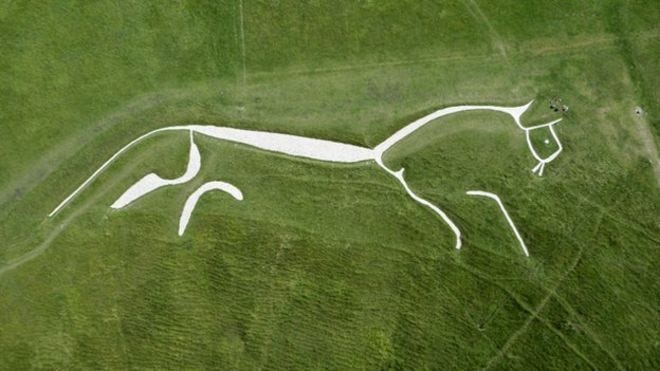
The 16 officially recognised chalk horses carved into various British hillsides speak to something of a fondness in the South for enormous geoglyphic art projects. Geoglyphs are defined as:
large scale designs or motifs created on the ground through rearrangement of natural local material such as stone, earth or mineral deposit.
Despite a wide range of stylistic interpretation from horse to horse, these hill figures are wonderfully consistent in the methodology of their creation. In order to achieve their signature brilliant white, turf is cut away from the hillside to reveal the chalk lying just beneath. Through this process, something called a ‘negative geoglyph’ is bought to life, with the artist removing layers of matter to create contrast between environment and motif.
Uffington
The Uffington horse carving is by far the oldest and perhaps the most enigmatic of this ragtag Southern herd. In 1990, the Oxford Archaeology team employed new Optically Stimulated Luminescence (OSL) technology using limestone from the carving itself to estimate an origin date. Deposits from the lowest levels of the horse strongly indicated the figure emerged between 1380 and 550 BC making this creature over 3000 years old—the earliest discovered geoglyph in Europe by some margin. Despite a birthday firmly in the late Bronze Age or Early Iron Age, the horse appears almost modernist in style.
At an impressive 110 metres from nose to tail, old Uff is rendered not in painstaking naturalism but as a series of bold, sweeping lines. More distinctly Picasso than Stubbs, the carving is abstract, almost skeletal in its composition. Truly, the geoglyph would not be out of place in a hip and happening Shoreditch gallery. Yet here the Uffington Horse has rested against a weathered hillside for millennia as testament, perhaps, to the human impulse to reduce matters to their bare essentials.
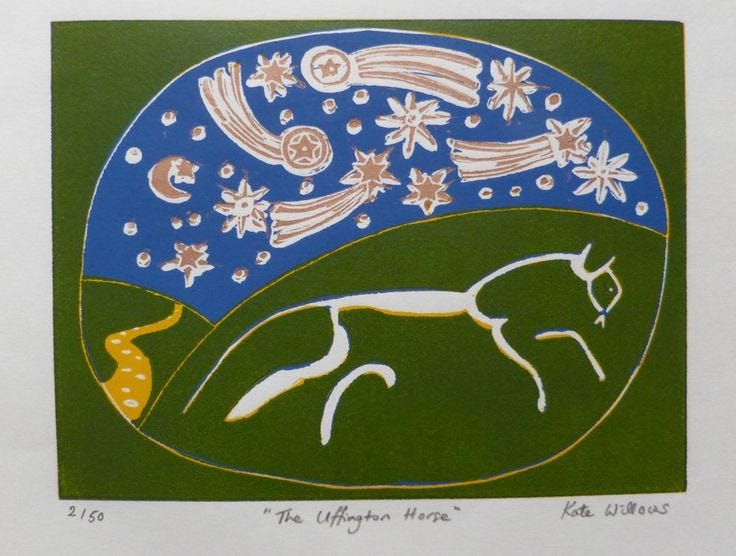
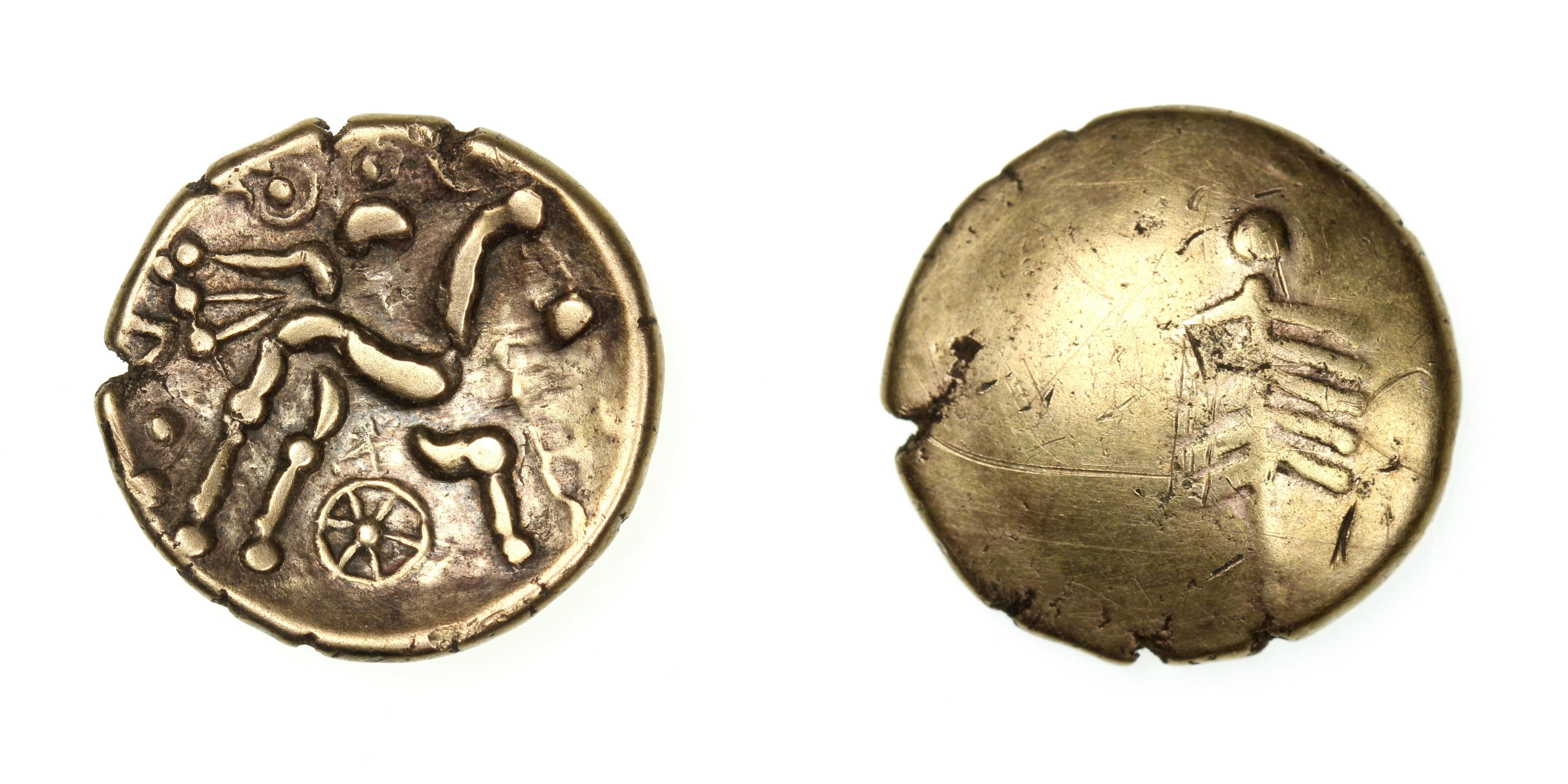
What no one can quite agree on is just how Uff came to be all those years ago. Leading theories range from the rather sensible to the gloriously speculative, as is often the way with our ancient monuments—I'm looking at you, Stonehenge. Many largely subscribe to the idea that the horse was something of a Bronze Age planning notice. A local tribe might have carved the hill as an attempt to assert control over the surrounding territory. Certainly, many scholars attribute the handiwork to local Celtic tribes the Dobunni or Atrebates and note a distinct similarity between the style of the carving and designs found on coins unearthed from the surrounding area. Further speculation posits that the horse was in fact a site of great importance for a Celtic horse cult. Yes you read that correctly. Some investigations venture that the act of etching the great work at such a high vantage might have been in efforts to appease the goddess Epona, patron of horses, ponies and grain. She is often thought to have escorted souls to the afterlife—appropriately on horseback—and her sinister counterpart Melanippe, a black ‘night mare,’ has associations with foul weather and dark arts in Celtic folklore.
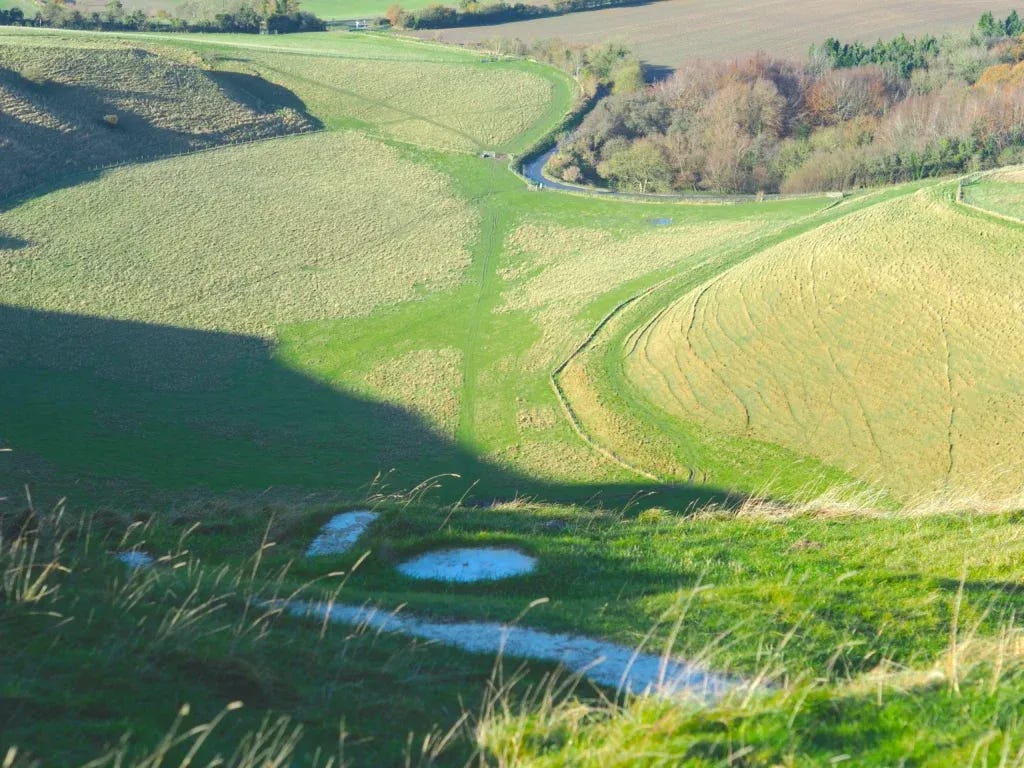
Interestingly, the track running below the Uffington White Horse is Icknield Way, thought to be the oldest road in Britain. The name itself may derive from the Celtic Eachanaidh, meaning the ‘people of the horse’, with further suggested links to the Iceni tribe. Erchofont, now known as Urchfont, could well have been the font or spring of the horses. Whether or not the etymology holds up to scrutiny, there is something pleasing in the idea that the oldest road in Britain runs beneath the oldest horse in Britain, and that both may have been named, in their different ways, for the same animal.
It is also interesting to note the parallels the carving carries with Welsh Goddess Rhiannon of the Mabinogi, who is often depicted atop her own white steed. As fun as this link is, little evidence suggests any direct influence. Perhaps my favourite—and arguably most poetic—of the theories surrounding Uff has been advanced in recent years by University of Southampton archaeologist Joshua Pollard. Pollard theorises that the figure was carved as a ‘solar horse’: a a physical expression of the ancient belief that the sun was dragged across the sky each day on horseback. And it must be said that the horse's position on the hill does align with the midwinter sun in a way that is difficult to dismiss as coincidence.
The earliest recording of the carving can be found in medieval Welsh Literature. The Llyfr Coch Hergest (Red Book of Hergest, 1375–1425) states that ‘Near to the town of Abinton there is a mountain with a figure of a stallion upon it, and it is white. Nothing grows upon it.’ Pretty spooky stuff. The horse also makes an appearance in the work of everyone's favourite antiquarian, John Aubrey, who noted it in the seventeenth century—which, given that Aubrey was also the man who first properly documented Stonehenge, suggests he had a reliable nose for a good monument. Aubrey suggested that perhaps the horse in fact originated from legendary Germanic brothers Hengist and Horsa who led the Angles, Saxons and Jutes, the progenitor groups of modern English people, in their invasion of Great Britain in the 5th century.
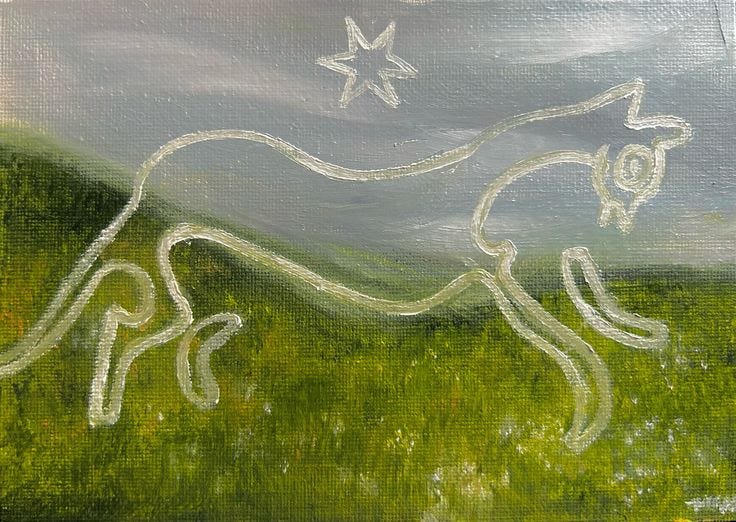
For all this very academic postulating, it may simply be that someone, three thousand years ago, looked at a hillside and thought: ‘yeah, that would be a good place for a horse.’ Human motivation has never been entirely rational, and there is no particular reason to assume it was any more so in 550 BC. Ultimately, we will never know the definitive origins of the great white horse—its dedicated artists have long since become part of the same chalky earth from whence it came. The not knowing, however, is part of the fun.
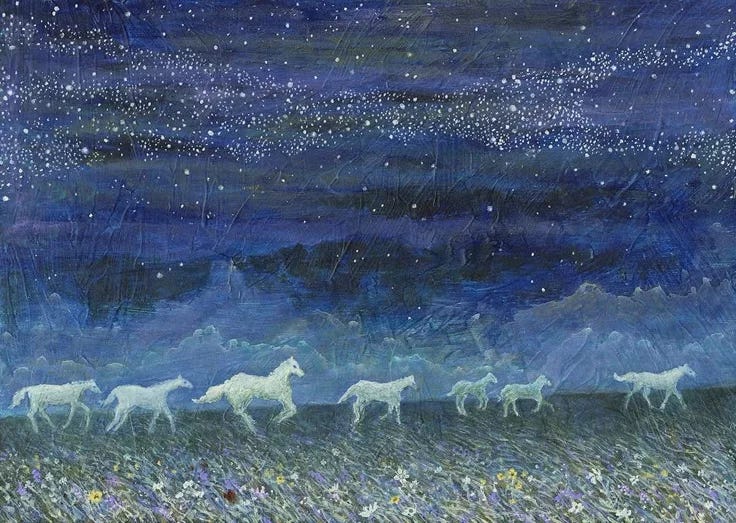
Naturally, with all this speculation comes folklore, developing steadily in the gaps between the official records. Mystery invites explanation, and it is no surprise just how many magical explanations this site has bred. Numerous tales concur that the horse is in fact a great mare, her foal once etched into a neighbouring hill, but since lost to nature. Legend has it that at night, the horse and her foal come down from the hills to drink from the bottom of the vale, aptly named ‘The Manger.’ The pair also drink from the Woolstone Wells nearby, thought to have been formed from the hoofprint of the horse herself. A local tradition also encourages those in need of a little luck to stand in the centre of the horse’s eye and spin three times to make a wish. This practice has since been discouraged due to the sheer amount of hopeful wishmakers eroding the eye! The carving also holds some excellent Arthurian lore, with many believing that when King Arthur finally awakens, she will dance atop Dragon Hill nearby—a brilliant image.
Westbury
Not too far from the vale, another white horse watches over the towns below. Just beyond Westbury can be found a distinctly more horsey-shaped horse. Some sources call this fellow the ‘Moon Stallion.’ Legend tells of this gentle giant leaving the hillside on a moonlit night as an enormous spectral stallion. The creature gallops along the Ridgeway, past Avebury and comes to rest beside his lover, the Uffington mare. By sunrise, the stallion has galloped all the way home once more, not a hoof out of place. Given that folk tell of a possible foal not too far from the Uffington hillside, I often like to think this chalky trio might be something of a little family.
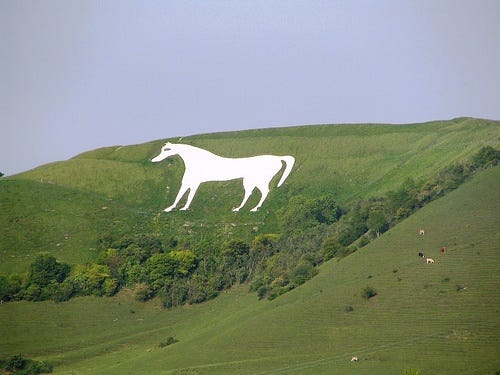
Despite the myriad tales that have emerged surrounding the chalk herd scattered across the south of England, most of the horses themselves are far younger than we might first assume. In fact, the Uffington Horse has so far preceded her herdmates that she might reasonably be considered the grand-mare of the entire tradition. After her Bronze Age debut, the chalk hills of southern England remained notably horse-free for the best part of three thousand years. It was not until the late 1600s that the Westbury Horse appeared in Wiltshire.
Beyond
Once Westbury had done it, everyone wanted one. Cherhill followed in 1780, Marlborough in 1804, Osmington in 1808, Alton Barnes in 1812, Hackpen in 1838, Broad Town in 1864. Yorkshire got in on the act with Kilburn in 1857. The twentieth century added a few more, including the Pewsey Horse, recut entirely in 1937, and—most brilliantly—the Bulford Kiwi in 1919, carved into a Wiltshire hillside by homesick New Zealand troops waiting for a boat home after the First World War, which is either deeply touching or a very impressive act of boredom, depending on how you look at it. The most recent arrival is the Folkestone Horse, completed in 2003 and overlooking the Channel Tunnel terminal—a location that feels somehow both very English and not English at all.
Most of these younger horses were simply carved by locals wanting to get in on the action. That crazy bunch known as the Victorians were downright obsessed with ancient antiquities, with follies popping up all over the place during the long nineteenth century. The craze became so popular, in 1949, writer Morris Marples half-jokingly coined the term ‘leucippotomy’ to describe ‘the cutting of white horses and gigantotomy for the cutting of giants on rare occasions.’ It might be noted neither of those terms appear in any dictionary but very well should.
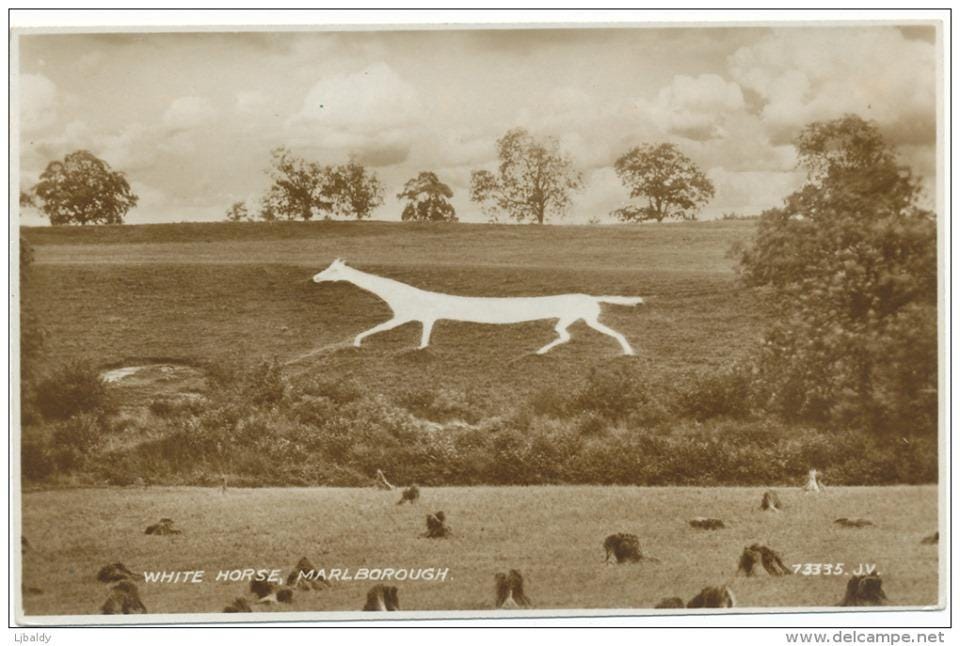
The smallest of the herd, residing in Marlborough, Wiltshire has perhaps my favourite origin story. The figure was cut in 1804 by boys at Mr Greasley's Academy. The horse was designed and marked out on the hill by a boy called William Canning who had long wished to create his own little bit of history. From then onwards, it was scoured every year, this becoming a tradition at the school marked by revelry. Greasley died about 1830, and the school was closed, leading to the horse being neglected for some years. By 1860, however, it was back in good condition and can be seen in a photograph taken that year at a cricket match. In 1873, Captain Reed, an old boy of Greasley's Academy who had taken part in the horse's creation, oversaw a new scouring that has continued since.
A verse of the Marlborough College school song actually refers to the horse:
And when to Marlborough old and worn we shall creep back like ghosts,
And see youngsters yet unborn run in between the posts,
Ah, then we’ll cry, thank God, my lads, the Kennett‘s running still,
And see, the old White Horse still pads up there on Granham Hill.
While others, such as the Osmington Horse—carved in 1808 to honour King George III, who was a frequent visitor to nearby Weymouth—were tied to rulers and grand occasions, the majority of the herd were etched into the hillside for no particularly exalted reason. A landowner fancied one. A local farmer thought it would be a nice idea. Some students did it for a laugh. This is, perhaps, the most wonderful thing about them.
The Herd Perseveres
There is something quite profound about a species that will, entirely unprompted, climb a hill and spend considerable effort scraping a large horse into it. Perhaps not for God, not for king, not for any reason that would satisfy a grant application—just because it seemed like a good idea at the time, and because the result was pleasing to look at. And then, having done it, will come back every few years for centuries to make sure it stays there. The horses require constant maintenance. Grass as we know, given half the chance, will always win over human effort. And yet generation after generation has turned up with tools and chalk and apparently nothing better to do, preserving figures that were made by people whose names nobody remembers, for reasons nobody can quite agree on. There is no practical argument for this. There is no return on investment. There is only the stubborn human insistence that the horse should remain visible, because it has always been visible, and because something would be lost if it were not which is, when you think about it, as good a definition of culture as any.
There is also something strangely selfless in the chosen figure. When given a blank canvas—or in this case, a blank hillside—the human instinct is usually toward the self. We carve our initials into trees. We draw stick figures that are, at some level, us. We leave smileys, signatures, the visual equivalent of I was here. The horse offers none of that. It confers no obvious glory on the carver, whose name, in almost every case, has been completely forgotten.
The horse is something older than ego. It carries with it centuries of association with freedom and nobility and the kind of romantic energy that makes a grown adult want to scrape one into a hill. Fundamentally an act of attention paid outward rather than inward, it is homage to the animal, to the landscape, to whoever might look up from the valley below and feel, briefly, that something extraordinary has been placed there for them. This perhaps explains why we keep making them. And why, three thousand years later, a writer on a train from Bristol can look up at precisely the right moment and feel, for just a second, that she has been let in on something.
This is such a lovely post. I read and loved Rosemary Sutcliff's 'Sun Horse, Moon Horse' when I was little - which I think is *such* a wonderful and chilling way of thinking through what might be behind this tradition. And when I was driving up past Kilburn to my IVF clinic, I passed the white horse every time, and it felt like a talisman.
Wow...I just LOVED this; fantastic research for sure, but so much more. Thanks for this excellent read...I was immediately hooked (being an archaeologist helps a bit, methinks!)...